Monday, June 27, 2016

This is Quite Possibly my Last Post

Welcome everyone to what may be my last post for this blog. And when I say “may be", I probably mean never, because I'm such a huge procrastinator that I will probably never open up this blog again. Anyway, I'll leave this blog with an open ended post just in case I decide to come back and write a new article.  That being said, let's get this started by announcing the most important piece of futuristic technology I have ever discussed: computer chip implants. Quite frankly, the idea seems absurd and farfetched, but computer chip implants could have endless applications for the world around us. 


Actually, I have already met someone who has a computer chip implant, but not in the way you might think. You see, this man was my tour guide during my Jazz band trip to New York, and he claims to have received computer chip implants behind his eyes. Of course, he acted as one of the test subjects for the company producing these chips (I believe it was google), which is why he managed to get them before they were released into the market.

Just an idea of what was placed in the tour guides eye. Don't worry though,
as far as I could tell, the chip wasn't even noticeable in his eye.
Either way, what he could do with these computer chips was amazing. Believe it or not, my tour guide was able to access pre-programmed that were implemented into his chip by simply closing his eyes! I was actually very surprised when he shut his eyes and recited a 30 second long monologue from a Shakespearean play without any hesitations at all. However, these computer chips are only the tip of the iceberg. Imagine the possibilities of a computer chip implanted into the human brain. Certain articles suggest that this would allow us to access the Internet using only our minds! We would essentially become a living encyclopedia with access to every piece of knowledge known to man! A certain show I used to watch, called Intelligence even based their TV show off of this idea and showed a man with the capability of accessing the internet at a moment’s notice, and even being able to create a digitized image of the information he could access. 

That being said, this technology will actually be a crucial part of society (once it's perfected, of course) because we humans must find a way to keep up with the ever improving computers and robotic technology of our world.  On the other hand, the show Intelligence also posed many questions regarding how safe these chips actually are. For example, it is possible that the computer chips implemented into the brain can be hacked, essentially allowing the hacker to take control of the person whose brain is connected to the chip. This would lead to catastrophic consequences because everyone with a chip in their brain would be in danger of being controlled, and crimes could be committed repeatedly without the hacker being caught. In addition, a chip implant also poses risks for health and well-being because of the risk of damaging the brain tissue during the chip implant procedure. This could possibly lead to paralysis or death.  
In conclusion, computer chip implants are, if perfected, going to revolutionize the world, but will also create many dangers for humans and society as a whole. With that in mind, I hope you guys have enjoyed my blog about the future of technology, and that you have learnt that technology is also an essential part of the future.    

Sources:

Sunday, June 26, 2016

The Future of Space Shuttles


The world will come to end. That is a fact that has been burned into my mind after having watched a series of episodes of How the Universe Works. Honestly, I was just really bored when I stumbled upon this show, and, due to the convenient lack of TV channels, I ended up watching a few to many of these episodes.

This show is perfect for a day when you're too lazy to even get up and make a cup of coffee.

Anyway, back to my point: the world will end. Either the sun will consume the earth, the moon will destabilize and create unstable axis rotation for the earth, leading to immense climate changes (from weather similar to that of the ice ages to weather at the equator) and death of all life,  or some other phenomenon will cause all life on earth to be obliterated.

Side note: I believe the most likely cause for the end of the world will be all the anthropic activities that will lead to unbearable living conditions for any species on earth. In other words, the global warming we create will lead to the end of most, if not all life on earth.

Trust me when I say the world will end. Maybe not like this, but the world will end.
 Another side note: I just realized that almost every episode of How the Universe Works is related in some way to the end of life on earth. Strange how a show about the entire universe always seems to focus on us and the earth instead of the bigger picture.

That being said, we humans have already been preparing  for the inevitable doomsday of earth by creating space shuttles. However, our technology for space travel is not advanced enough for us to travel to another life sustaining planet that may be light years away. Heck, with our current technology, we can't even leave our solar system! Fortunately, there are people who have found hypothetical solutions to that problem (other than living on Mars), that will also lead to incredible advancements in space travel/exploration.
Do we even want to live on a planet as desolate as mars? 
 
The first solution to our space travel dilemma presents a very intriguing concept that is also extremely cool. The idea is that we use antimatter, a substance that releases energy on contact with regular matter, as a source of fuel. This would allow space shuttles to travel at 15% the speed of light ,compared to the current speed of space shuttles which is only 0.00259 % the speed of light. The other option is to harness the power of hydrogen fusion (also used by the sun) which would allow us to move at 10% the speed of light. One way over the other, it's a huge improvement from what we had before.

As a consequence of this new technology, we will be able to complete incredible things beyond our wildest imaginations. We will be able to examine in precise detail the makeup of nebulas and far away comets, make new observations and see further into our galaxy than ever before! We may even discover a few of the secrets contained by the universe that would explain the origin of the universe or the existence of black matter!

To be able to explore all the areas of our galaxy close up would be amazing!
On top of that, with our newfound ability to travel great distances, we will be able to find a new habitable planet where we can establish colonies, similar to how settlers established colonies in North America back in the 17th century. However, the best part of this new technology, which will be a true crowd pleaser for Star Wars fans, will be the fact that we can now travel in a state similar to light speed.
15% the speed of light is close enough, right?
Anyway, to wrap up this blog post, I must say that it's comforting to know that some humans are already preparing for the day when we destroy the earth, and that the human race will carry on.  

Monday, April 18, 2016

Reality headsets


Welcome, readers of this blog! Today I'm going to dedicate an entire post relating to one specific piece of technology: reality headsets. This is in part thanks to the tv series SAO (Sword Art Online) which introduced me to the concept of reality headsets. In the tv series, the reality headset is a helmet with a visor that let you enter a virtual world. The headset then uses your brain waves to move your body inside the virtual world, and triggers some of your neural connections to make you feel your five senses : sight, hearing, taste, touch and smell.


Image result for sao nerve gear
Sword Art Online's virtual reality headset, know as NerveGear.
 However, our virtual reality headsets are much different than the ones displayed in the SAO (which, by the way, takes place in the year 2022). Here, the headsets use sensors to detect and analyse your motion, from which it reacts. This makes it so that the screen or the visors image can move accordingly and reflect reality. Sadly, I'm not aware of any device capable of reenacting the five senses, and their have been no articles suggesting progress towards this goal.

Despite this fact, I still find this VR technology to be groundbreaking. To create an immersive gaming experience with such depth and detail is a truly incredible feat. The video listed below will give you an idea of what you would experience with a VR headset. That being said, please take note that the experience with an actual VR headset would be much better, because instead of the screen being displayed flat surface (your computer) it will covers all the angles of your sight. This means you can only see the screen of the virtual reality headset, which then creates the illusion that you are part of the game.
Now, as far as I'm concerned, this is the future of gaming. In fact, as far as I can tell from the videos I've watched, these headsets create an experience unlike any other, allowing the user of the headset to enter a whole new world. At the same time, this device makes gaming much more interactive and suspenseful because the barrier between reality and video games is broken. The games that come along with these headsets are also very unique in there structure, and very captivating to look at. The gaming clip bellow proves just that with it's star wars reminiscent game design and incredible artwork. 

All in all, virtual reality headsets show the potential of future technology and show us that we are closing in on that futuristic world that we all yearn for.


Sunday, April 3, 2016

Humans vs. Robots

In my last post, I had said that the robots of today are very close to being considered equal with human, if not superior. That being said, this post is dedicated to examining to what extent humans and robots are equal, and to what extent one is superior to the other. I will also explore the domains where a robot may soon surpass humans.

Image result for robots and human

However, humans and robots are two very different things, so comparing them is like comparing an apple to an orange. As a consequence, comparing both of them would mean that they would both be on unfair terms. In fact, without any guidelines for comparison a robot would beat out any human when it comes to a number of manual tasks, because they can be constructed with certain specifications. In comparison, humans appear generally in one form. In the same way, humans and robots have different processes of thought. Humans are the ones who ponder and question whereas robots only use information available.


Image result for apple vs orange
Is there really any resemblence ?
That being said, to make comparisons on fair grounds, I will follow a simple guideline. Simply put, for most of the evaluations, I will compare the best humans to the best robots, because the most skilled humans in a certain category have built themselves to be specialized in certain area, just like robots who have been built for a certain purpose. However, for the broader categories such as "Intelligence", I will compare the strengths and weaknesses of both humans and robots to get a more accurate picture.

Round 1: Intelligence
Now, the first question that must be asked is which is more intelligent, a robot or a human? Well, we've already seen that robots are more knowledgeable than humans (IBM Watson has demonstrated this first hand) and that they have computational power that exceeds humans by a long shot. However, while robots are excellent at computing and finding answers, they are a lot less capable when it comes to analyzing and finding patterns. This is where humans excel. A human can easily look at a picture and determine the events that had occurred whereas a robot would struggle to identify what had happened. This is because robots still rely on facts and solid information instead of finding what is most probable. As a consequence, humans and robots tie in this category. Robots can process facts and information at a quicker rate, but humans can analyse and develop theories.

Image result for human vs robot brain
Round 2: Manual labor


When it comes to a set task, nothing can defeat a robot. They are programmed in a way so that everything is repeated over and over without any errors. On top of that, they never need to rest, so the tasks they perform can be done without end. With that in mind, isn't it clear that robots are superior when it comes to manual labor? The shocking answer: not even close. The problem with these robots is that their programming only allows them to function within certain parameters. If there is even a slight anomaly, say, an object is an inch away from where it's supposed to be, the robot won't be able to complete it's task. It'll most likely knock over the object or miss it entirely. This would be the case for a robot who would try to pick an apple from an apple tree.
Image result for Human farmer picking an apple
Such a simple task, right? Not for robots!

In comparison, humans don't have this problem and can adapt to a situation without any difficulty. At the same time, they can operate in many different conditions and can complete more difficult tasks at a much quicker pace than robots. Why do you think humans still collect harvests from the fields? They are simply more efficient than any robot there is.


That being said, seeing as humans can perform many more manual tasks than robots, I believe that humans are superior at manual labor. One more point for the humans!

Final round: Human competitions against robots

There are many different competitions in which humans participate, too many to count. Either way, each of these competitions always have someone who is considered the best in that category. That being said, if we placed robots against the best of the best, how do they match up? In some categories, such as the ones involving thought, computers will win. Take chess for example. Robots are superior to humans in this game to such an extent that they are placed in their own leagues instead playing alongside humans. In fact, robots had surpassed the best in chess back in 1997, when Deep Blue, a chess supercomputer, defeated Gary Kasparov, the best chess player of his time, with a final score of 3.5 to 2.5.

However, when faced with challenges involving agility and dexterity, robots haven't quite surpassed humans. For example, in a match of table tennis against Timo Boll, one of the greatest table tennis players of all time, the agile robot KUKA lost, proving that humans still remain superior to machines in certain ways.

I know it's a slightly exaggerated, but this commercial video is valid (as far as I know) and proves my point on humans still having beat out robots in dexterity challenges.
That being said, this round is a tie between robots, which can (barely) defeat humans at intellectual games and humans that can (barely) defeat robots at dexterity challenges.

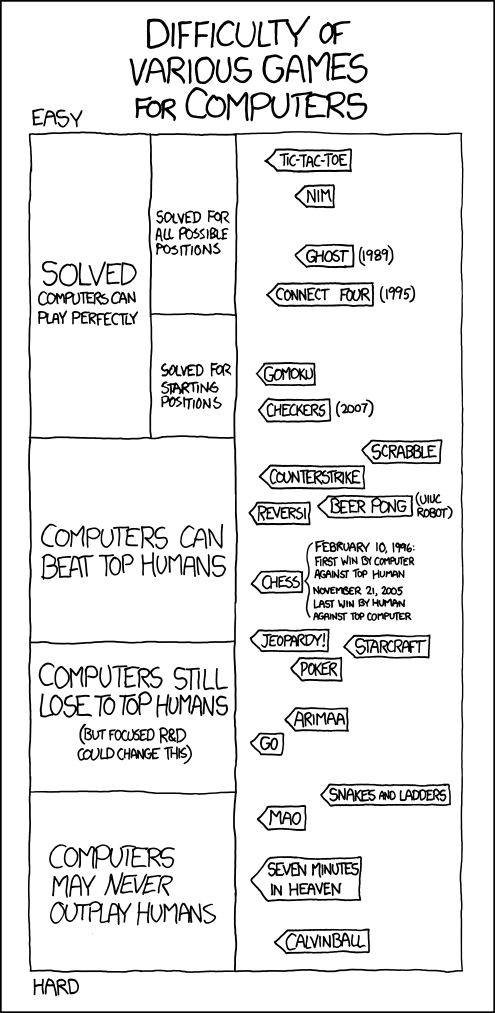
In conclusion, humans are still generally superior to robots when it comes to anything other than intellectual challenges. However, with the rapid development of robots and their abilities, robots will soon overtake us in every single way. Every single way, that is, except Calvin Ball.


Sources:
1. http://blog.bobsica.com/2012/01/computers-will-never-win-at-calvinball.htm
2.http://www.03.ibm.com/ibm/history/ibm100/us/en/icons/deepblue/
3.http://www.kuka-timoboll.com/en/the-perfect-match/
4.https://xkcd.com/1002/
5. The book What if?
6. My experience involving robotics