Welcome to a blog dedicated to the technology of the future. Here you will find everything from absurd technological toys to the most intriguing spaceship theories we have ever seen!
Welcome, readers of this blog! Today I'm going to dedicate an entire post relating to one specific piece of technology: reality headsets. This is in part thanks to the tv series SAO (Sword Art Online) which introduced me to the concept of reality headsets. In the tv series, the reality headset is a helmet with a visor that let you enter a virtual world. The headset then uses your brain waves to move your body inside the virtual world, and triggers some of your neural connections to make you feel your five senses : sight, hearing, taste, touch and smell.
Sword Art Online's virtual reality headset, know as NerveGear.
However, our virtual reality headsets are much different than the ones displayed in the SAO (which, by the way, takes place in the year 2022). Here, the headsets use sensors to detect and analyse your motion, from which it reacts. This makes it so that the screen or the visors image can move accordingly and reflect reality. Sadly, I'm not aware of any device capable of reenacting the five senses, and their have been no articles suggesting progress towards this goal.
Despite this fact, I still find this VR technology to be groundbreaking. To create an immersive gaming experience with such depth and detail is a truly incredible feat. The video listed below will give you an idea of what you would experience with a VR headset. That being said, please take note that the experience with an actual VR headset would be much better, because instead of the screen being displayed flat surface (your computer) it will covers all the angles of your sight. This means you can only see the screen of the virtual reality headset, which then creates the illusion that you are part of the game.
Now, as far as I'm concerned, this is the future of gaming. In fact, as far as I can tell from the videos I've watched, these headsets create an experience unlike any other, allowing the user of the headset to enter a whole new world. At the same time, this device makes gaming much more interactive and suspenseful because the barrier between reality and video games is broken. The games that come along with these headsets are also very unique in there structure, and very captivating to look at. The gaming clip bellow proves just that with it's star wars reminiscent game design and incredible artwork.
All in all, virtual reality headsets show the potential of future technology and show us that we are closing in on that futuristic world that we all yearn for.
In my last post, I had said that the robots of today are very close to being considered equal with human, if not superior. That being said, this post is dedicated to examining to what extent humans and robots are equal, and to what extent one is superior to the other. I will also explore the domains where a robot may soon surpass humans.
However, humans and robots are two very different things, so comparing them is like comparing an apple to an orange. As a consequence, comparing both of them would mean that they would both be on unfair terms. In fact, without any guidelines for comparison a robot would beat out any human when it comes to a number of manual tasks, because they can be constructed with certain specifications. In comparison, humans appear generally in one form. In the same way, humans and robots have different processes of thought. Humans are the ones who ponder and question whereas robots only use information available.
Is there really any resemblence ?
That being said, to make comparisons on fair grounds, I will follow a simple guideline. Simply put, for most of the evaluations, I will compare the best humans to the best robots, because the most skilled humans in a certain category have built themselves to be specialized in certain area, just like robots who have been built for a certain purpose. However, for the broader categories such as "Intelligence", I will compare the strengths and weaknesses of both humans and robots to get a more accurate picture.
Round 1: Intelligence
Now, the first question that must be asked is which is more intelligent, a robot or a human? Well, we've already seen that robots are more knowledgeable than humans (IBM Watson has demonstrated this first hand) and that they have computational power that exceeds humans by a long shot. However, while robots are excellent at computing and finding answers, they are a lot less capable when it comes to analyzing and finding patterns. This is where humans excel. A human can easily look at a picture and determine the events that had occurred whereas a robot would struggle to identify what had happened. This is because robots still rely on facts and solid information instead of finding what is most probable. As a consequence, humans and robots tie in this category. Robots can process facts and information at a quicker rate, but humans can analyse and develop theories.
Round 2: Manual labor
When it comes to a set task, nothing can defeat a robot. They are programmed in a way so that everything is repeated over and over without any errors. On top of that, they never need to rest, so the tasks they perform can be done without end. With that in mind, isn't it clear that robots are superior when it comes to manual labor? The shocking answer: not even close. The problem with these robots is that their programming only allows them to function within certain parameters. If there is even a slight anomaly, say, an object is an inch away from where it's supposed to be, the robot won't be able to complete it's task. It'll most likely knock over the object or miss it entirely. This would be the case for a robot who would try to pick an apple from an apple tree.
Such a simple task, right? Not for robots!
In comparison, humans don't have this problem and can adapt to a situation without any difficulty. At the same time, they can operate in many different conditions and can complete more difficult tasks at a much quicker pace than robots. Why do you think humans still collect harvests from the fields? They are simply more efficient than any robot there is.
That being said, seeing as humans can perform many more manual tasks than robots, I believe that humans are superior at manual labor. One more point for the humans!
Final round: Human competitions against robots
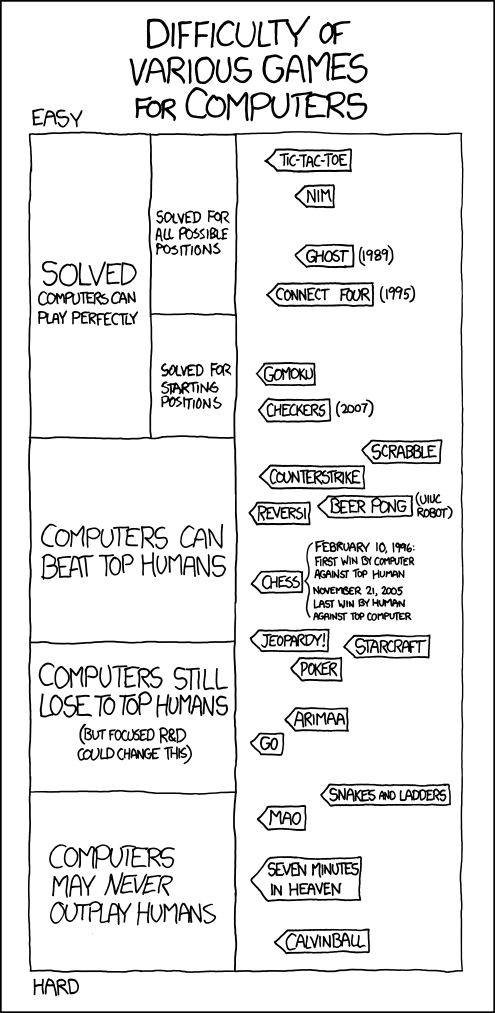
There are many different competitions in which humans participate, too many to count. Either way, each of these competitions always have someone who is considered the best in that category. That being said, if we placed robots against the best of the best, how do they match up? In some categories, such as the ones involving thought, computers will win. Take chess for example. Robots are superior to humans in this game to such an extent that they are placed in their own leagues instead playing alongside humans. In fact, robots had surpassed the best in chess back in 1997, when Deep Blue, a chess supercomputer, defeated Gary Kasparov, the best chess player of his time, with a final score of 3.5 to 2.5.
However, when faced with challenges involving agility and dexterity, robots haven't quite surpassed humans. For example, in a match of table tennis against Timo Boll, one of the greatest table tennis players of all time, the agile robot KUKA lost, proving that humans still remain superior to machines in certain ways.
I know it's a slightly exaggerated, but this commercial video is valid (as far as I know) and proves my point on humans still having beat out robots in dexterity challenges.
That being said, this round is a tie between robots, which can (barely) defeat humans at intellectual games and humans that can (barely) defeat robots at dexterity challenges.
In conclusion, humans are still generally superior to robots when it comes to anything other than intellectual challenges. However, with the rapid development of robots and their abilities, robots will soon overtake us in every single way. Every single way, that is, except Calvin Ball.